

मानवी वस्ती व भूमी उपयोजन टिपा लिहा
Marathi and English Medium

Manavi Vasti ani Bhumi Upyojan Tipa Liha
- ग्रामीण व नागरी वस्त्यांमधील आंतरक्रिया.
- नागरी वस्तींच्या समस्या
- उपनगरे
- संमिश्र भूमी उपयोजन क्षेत्र.
- लोकसंख्येच्या आधारावरुन नागरी वस्त्यांचे प्रकार –
- ग्रामीण व नागरी झालर क्षेत्र-
1) ग्रामीण व नागरी वस्त्यांमधील आंतरक्रिया.
उत्तर-
① वस्त्यांचे ग्रामीण व नागरी असे प्रकार केले जातात. दोन्ही प्रकारच्या वस्त्यांमध्ये कोणते ना कोणते कार्य चालत असतेच.
② ग्रामीण भागात प्राथमिक व्यवसाय अधिक चालतो त्यामुळे ग्रामिण वस्त्यांमधुन भाजीपाला, अन्नधान्य, दुध, मांस, अंडी, फळे व फुले अशा प्रकारच्या वस्तुचा पुरवठा नागरी वस्त्यांना होत असतो.
③ ग्रामिण वस्तींमधुन उद्योगांना लागणारा अनेक प्रकारचा कच्चामाल नागरी भागातील उदयोगधंदयांना मिळत असतो
④ नागरी भागात उदयोगधंदे, व्यापार यांचे प्रमाण जास्त असल्याने व्दितियक, तृतीयक, व चतुर्थक व्यवसाय अधिक चालतो. नागरी भागातून तयार झालेला पक्का माल व विविध सेवा या ग्रामीण वस्त्यांना पुरवल्या जातात.
⑤ वाहतूक व पर्यटनासाठी ग्रामिण व नागरी भाग एकमेंकावर अवलंबुन असतात.
⑥ ग्रामीण भागातील लोक विविध कार्यासाठी, व्यापार करण्यासाठी नागरी वस्तीवर अवलंबून असतात.
⑦ नागरी भागातील शैक्षणिक व वैदयकीय सुविधा, प्रशासकीय कामकाज मनोरंजन, क्रिडा या सारख्या सेवासाठी ग्रामिण भागातील लोक नागरी भागावार अवलंबुन असतात.
⑧ नागरी भागातील उदयोगव्यवसायांसाठी स्वस्त व मुबलक मजुर पुरवठा हा ग्रामिण भागातुन होत असतो.
अशाप्रकारे ग्रामीण व नागरी वस्त्यांमध्ये आंतरक्रिया चालतात.
Manavi Vasti ani Bhumi Upyojan Tipa Liha
2) नागरी वस्तींच्या समस्या–
उत्तर-
नागरी वस्तीच्या वाढीबरोबरच नागरी वस्तीच्या समस्या मध्ये ही दिवसेंदिवस वाढ होताना दिसत आहे. त्या समस्या खालील प्रमाणे आहेत.
① आर्थिक समस्या – नागरी भागात जास्तीच्या लोकसंख्येमुळे सर्वांनाच उदयोग, व्यवसाय किंवा रोजगार मिळेल याची खात्री नसते. त्यामुळे बेरोजगारीची समस्या निर्माण होते. जीवनाअवश्यक वस्तूची टंचाई निर्माण होवुन महागाई वाढते.
② सामाजिक समस्या – नागरी भागात येणारे लोकसंख्येचे लोंढे, वेगवेगळया विचारांचे व समुदायाचे असल्याने सर्वांचे विचार जुळतीलच असे नसते. त्यातुन प्रांतवाद, वर्चस्ववाद, राजकीय फायदे तोटे, जातीय वाद अशा बाबीतुन अनेक प्रकारच्या सामाजिक समस्या निर्माण होत असतात.
③ सांस्कृतिक समस्या – नागरी वस्त्यांमध्ये वेगवेगळ्या प्रदेशातून येणाऱ्या लोकांमुळे संस्कृतीक भिन्नता, भाषावाद, प्रांतवाद व धार्मिक वाद निर्माण होतो.
④ पायाभूत सोयी सुविधांची कमतरता – वाढत्या लोकसंख्येमुळे पाणी पुरवठा, वीज व रस्ते, वैदयकीय सुविधा, शैक्षणिक सुविधा, अशा प्रकारच्या नागरी पायाभूत सोयी-सुविधांवर ताण निर्माण होतो. जागेच्या अडचणींमुळे झोपडपटटयांची निर्मिती होते त्यातुन अस्वच्छ परीसराचे प्रमाण वाढते.
⑤ पर्यावरणीय समस्या वाढते – नागरीकरणामुळे मोठया शहरांमध्ये जल, वायू, कचरा व ध्वनी इ. प्रकारचे प्रदूषण वाढत आहे.
⑥ प्रशासकीय समस्या – नागरी भागातील वाढत्या लोकसंख्येला प्रशासकीय सेवा सुविधा पुरविण्यात अडचणी येतात भ्रष्टाचाराचे प्रमाण वाढते. अवैध धंदे वाढतात, वाहतूक कोंडी सारख्या समस्या निर्माण होतात.

3) उपनगरे
उत्तर-
① महानगरांच्या सीमावर लहान आकाराची नगरे, लहान शहरे किंवा मोठी नगरे असतात. अशा नागरी क्षेत्रात उपनगरे म्हणतात. उदा. भांडूप, कल्याण, विरार इ. मुंबई महानगराची उपनगरे आहेत.
② महानगरांच्या परिसरात व्यापार, उदयोगधंदे, शिक्षण आरोग्य व इतर आकर्षक घटकांमुळे ग्रामिण भागातील लोक स्थलांतर करीत असतात. यातुन अशा ठिकाणी दाट लोकवस्ती निर्माण होवुन जागेच्या समस्या निर्माण होत असतात पर्यायाने लोक शहरांच्या बाहेरील भागात वस्त्यांची निर्मिती करतात त्यातुन उपनगरे तयार होतात.
③ सर्व उपनगर मुख्यशहरांच्या विकासाच्या परिणामाने वाढलेले असतात. शहरात जागेच्या किंमती जास्त असतात त्यामुळे शहरांच्या बाहेरच्या भागात तुलनेने कमी किंमत असल्याने उपनगरांची निर्मीती होत असते.
④ उपनगरे आर्थिक व इतर कार्यासाठी मुख्य महानगरावर अवलंबून असतात.
⑤ उपनगरे ही मोठया व औदयोगिक शहरांना लागुन तयार होतात. पुणे शहराची वाकड, हिंजवाडी ही उपनगरे आहेत.
⑥ मुख्य शहर हे उपनगरांना रेल्वे, रस्ते व मेट्रो अशा प्रकारच्या वाहतूक सुविधांनी जोडलेले असतात. त्यामुळे उपनगरे कालांतराने मुख्य शहरांमध्ये विलीन होत जातात.
⑦ मुख्य शहरांप्रमाणे उपनगरांना प्रांतवाद, भाषावाद, पाणी टंचाई, वीज टंचाई प्रदुषणाच्या समस्या जाणवत असतात.
Manavi Vasti ani Bhumi Upyojan Tipa Liha
4. संमिश्र भूमी उपयोजन क्षेत्र.
उत्त्तर–
① मानव ज्या ज्या कामांसाठी भूमीचा उपयोग करत असतो त्यास भूमी उपयोजन असे म्हणतात. आणि मानव एकाच परीसरात अनेक व वेगवेगळया कामांसाठी भूमीचा वापर करील असेल तेव्हा ते समिश्री भूमी उपयोजन होते.
② संमिश्र भूमी उपयोजन हे नागरी वसाहतीमंध्ये जास्त प्रमाणात पहावयास मिळते.
③ नागरी भागात निवासी, व्यावसायिक, औद्योगिक, मनोरंजन, क्रिडा, वाहतूक, व्यापारी क्षेत्र, संस्थात्कम क्षेत्र, अशा विविध बाबीसाठी भूमी उपयोजन आढळून येते.
④ नागरी भागात घरे, व्यवसाय, दुकाने, शाळा, दवाखाने, खेळाचे मोकळे मैदाने, रस्ते, बसस्थानके, औदयोगिक इमारती एकाच ठिकाणी एकत्रीत असतात या भागात सर्व प्रकारचे सेवा व कार्य एकत्र आढळतात.

5) लोकसंख्येच्या आधारावरुन नागरी वस्त्यांचे प्रकार –
उत्तर-
अ) नागरी वस्त्यांचे लोकसंख्येच्या आधारावरून खालील प्रकार करता येतात.

1) नगर –
ज्या नगरी वस्तीची लोकसंख्या १,००,००० पर्यंत असते त्या वस्तीला नगर म्हणतात. नगरात विविध प्रकारची कार्य चालत असतात. तर ग्रामीण वस्तीची विकसित अवस्था म्हणजे नगर होय. तालुका व तालुक्यातील काही मोठ्या ठिकाणांचाही यात समावेश होतो. या प्रकारच्या वस्तीत शाळा, दवाखाने, पोस्ट ऑफिस, इ. सुविधा असतात.
2) शहर –
एक लाखापेक्षा जास्त व दहा लाकापेक्षा कमी लोकसंख्या असलेल्या नागरी वस्त्यांना शहर असे म्हणतात. नगराची विकसित अवस्था म्हणजे ‘शहर‘ होय. नगरापेक्षा शहर आकाराने, लोकसंख्येने मोठे व विकसीत असतात शहरात नगरापेक्षा कार्याची विविधता जास्त असते. शहरे ही प्रशासन व्यापार, उच्चशिक्षण व दळणवळणाची केंद्रे असतात.
3) महानगरे –
जेव्हा शहराची लोकसंख्या 10 लाख ते 20 लाख दरम्यान असते तेव्हा त्या शहराला महानगरे किंवा दशलक्षी शहर असे म्हणतात. महानगरे ही व्यापारी केंद्रे, प्रशासकीय ठिकाणे, प्रादेशिक राजधानीची ठिकाणे असतात.
उदा. पुणे, नागपूर ही दशलक्षी शहरे आहेत.
4) महाकाय नगर-
सामन्यता ज्या शहरांची लोकसंख्या 50 लाखांपेक्षा जास्त असते त्या शहरांना महाकायनगर / प्रमहानगर / अतिविशालनगर असे म्हणतात.
भारतातील मुंबई शहर, मुंबई उपनगर व अनेक उपनगरे मिळून प्रमहानगर तयार झाले आहे. उदा. मुंबई शहर हे भारतातील सर्वात मोठे महाकायनगर आहे. न्यूयार्क, वाशिंग्टन, टोकियो, दिल्ली इ. हा जगातील महाकाय नगरे आहेत.
5) नगरांचा समूह – हा शहरीकिं वा त्यापेक्षा मोठया वस्त्यांचा पट्टा असतो किंवा समूह असतो यात प्रत्येक वस्तीची लोकसंख्या वीस हजारापेक्षा जास्त असते व सर्व वस्त्या एकमेंकांना लागुन असतात. त्याच्यांत कोणतही मोकळी जागा नसते.
6) बाहयवाढ नगर – वस्तींचा हा प्रकार एका मोठया शहराच्या अगदी जवळचा भाग असतो परंतु त्या शहराच्या बाहय सिमेवर विकसीत झालेला वेगळया वस्तीचा असतो. येथे या वस्तींच्या स्वत: च्या नागरी सुविधा असतात. उदा. सैन्य दलाची छावणी, शासकीय निवासी वसाहत, एखादया मोठया प्राजेक्ट किंवा उदयोगाच्या कामगाराची निवास व्यवस्था इ.
6) ग्रामीण व नागरी झालर क्षेत्र-
उत्तर–
① ग्रामीण व नागरी क्षेत्रांमधील भूमीस ग्रामीण नागरी झालर क्षेत्र असे म्हणतात.
② या क्षेत्रात ग्रामीण आणि नागरी अशी दोन्ही वैशिष्ट्ये आढळतात. हे क्षेत्र वेगळे नसून या दोहोंमधील संक्रमण क्षेत्र असते.
③ या क्षेत्रात ग्रामीण व नागरी असे दोन्ही प्रकारचे भूमी उपयोजन आढळते.
④ झालर क्षेत्राची रचना त्यामुळे गुंतागुंतीची असते. या भागात दोन प्रकारच्या प्रशासकीय सेवा आढळतात. उदा. ग्रामपंचायत आणि नगरपालिका.
⑤ झालर क्षेत्राजवळील नागरी क्षेत्र स्वतःची ओळख घालवून बसते. प्रत्यक्षात ही नगरे मोठ्या शहरात विलीन होऊन जातात.
⑥ या क्षेत्रात सोयी कमी दर्जाच्या असतात.
⑦ झालर क्षेत्रातील शेतीसाठी वापरात असलेली जमीन कालांतराने निवासी क्षेत्रात किंवा औद्योगिक क्षेत्रात परावर्तित होते.
⑧ या क्षेत्राची सरमिसळ ग्रामिण व नागरी अशा बाजूंनी झालेली असते. ग्रामीण-नागरी झालर क्षेत्रातून अनेक नागरीक शहराच्या मध्यवर्ती भागाकडे त्यांच्या कार्यालयात किंवा आर्थिक संस्थांमध्ये कामासाठी येतात.

हे वाचा
मानवी वस्ती व भूमी उपयोजन प्रकरणावरील वस्तुनिष्ठ प्रश्न व उत्तरे
पहीली ते बारावी पर्यन्तचे पाठय पुस्तके डाऊलोड करा.
बारावी भूगोल मानवी वस्ती व भूमी उपयोजन प्रकरणावरील भौगोलिक कारणे दया व त्यांची उत्तरे
बारावी भूगोल मानवी वस्ती व भूमी उपयोजन प्रकरणावरील फरक स्पष्ट करा.
Manavi Vasti ani Bhumi Upyojan Tipa Liha

Write Short Notes
1) Interaction between Rural and Urban Settlements
- Settlements are broadly classified into rural and urban types. Some form of economic or social activity is always carried out in both types of settlements.
- Primary occupations are dominant in rural areas. Therefore, rural settlements supply vegetables, food grains, milk, meat, eggs, fruits, and flowers to urban settlements.
- Many types of raw materials required for industries are supplied from rural areas to urban industrial centers.
- Since industries and trade are more developed in urban areas, secondary, tertiary, and quaternary occupations are dominant there. Finished goods and various services produced in urban areas are supplied to rural settlements.
- Rural and urban areas are interdependent for transport and tourism activities.
- People from rural areas depend on urban settlements for various activities and for trade purposes.
- For educational and medical facilities, administrative work, entertainment, and sports facilities, rural people depend on urban areas.
- Urban industries and businesses receive cheap and abundant labour supply from rural areas.
Thus, continuous interaction exists between rural and urban settlements.
2) Problems of Urban Settlements
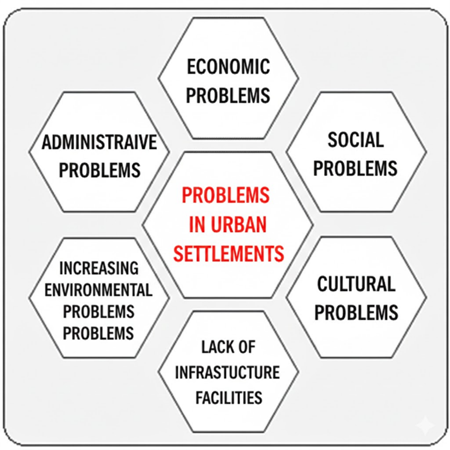
With the growth of urban settlements, the problems related to urban areas are also increasing day by day. These problems are as follows:
- Social Problems – Due to the influx of people with diverse backgrounds, ideologies, and communities, differences in opinions arise. This leads to regionalism, dominance conflicts, political issues, and caste conflicts.
- Economic Problems – Due to excessive population in urban areas, employment opportunities are not available to everyone. This leads to unemployment. Scarcity of essential commodities results in inflation.
- Cultural Problems – Migration of people from different regions causes cultural diversity, language conflicts, regionalism, and religious disputes in urban settlements.
- Lack of Infrastructure Facilities – Increasing population puts pressure on water supply, electricity, roads, medical facilities, and educational institutions. Due to shortage of space, slums develop, resulting in unhygienic surroundings.
- Environmental Problems – Urbanization increases water pollution, air pollution, solid waste pollution, and noise pollution in large cities.
- Administrative Problems – Providing administrative services to the growing urban population becomes difficult. Corruption increases, illegal activities grow, and problems such as traffic congestion arise.
3) Suburbs
- Small towns or cities located on the outskirts of metropolitan cities are known as suburbs. For example, Bhandup, Kalyan, and Virar are suburbs of Mumbai.
- Due to trade, industries, education, healthcare, and other attractive factors around metropolitan cities, people migrate from rural areas. This results in high population density and space problems, forcing people to settle outside the main city, leading to the development of suburbs.
- All suburbs grow as a result of the development of the main city. Due to high land prices in cities, comparatively cheaper land outside the city promotes suburban growth.
- Suburbs depend on the main metropolitan city for economic and other activities.
- Suburbs develop around large and industrial cities. Wakad and Hinjewadi are suburbs of Pune.
- Suburbs are connected to the main city by railways, roads, and metro transport. Over time, suburbs gradually merge into the main city.
- Like main cities, suburbs also face problems such as regionalism, language conflicts, water scarcity, electricity shortages, and pollution.
—————————————–
Manavi Vasti ani Bhumi Upyojan Tipa Liha
4) Mixed Land Use Zone
Answer:
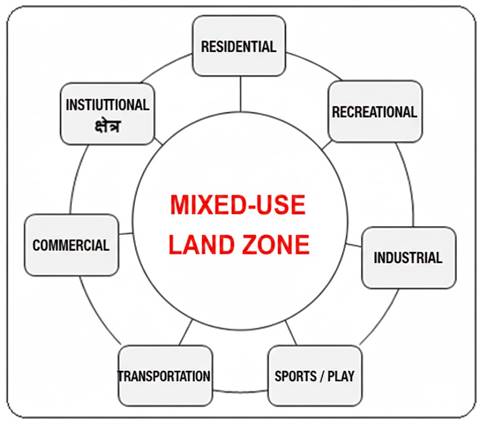
- The use of land by human beings for various activities is known as land use. When land in the same area is used for many different activities, it is called mixed land use.
- Mixed land use is commonly observed in urban settlements.
- In urban areas, land is used for residential, commercial, industrial, recreational, sports, transport, trade, and institutional purposes.
- In urban regions, houses, businesses, shops, schools, hospitals, playgrounds, roads, bus stands, and industrial buildings are found together in the same area. Therefore, all types of services and activities are concentrated in one place.
5) Types of Urban Settlements Based on Population
Urban settlements can be classified into the following types on the basis of population:
1) Town
An urban settlement with a population of up to 100,000 is called a town. Various activities take place in towns. A town represents the developed stage of a rural settlement. Taluka headquarters and some large rural centers are included in this category. Facilities such as schools, hospitals, and post offices are available.
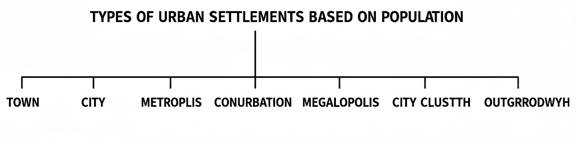
2) City
Urban settlements having a population of more than 100,000 but less than 1 million are called cities. A city is a more developed stage of a town. Cities are larger in area, population, and development. The diversity of functions is greater than in towns. Cities act as centers of administration, trade, higher education, and transportation.
3) Metropolis
When the population of a city is between 1 million and 2 million, it is called a metropolis or million city. Metropolises function as commercial centers, administrative centers, and regional capitals.
Examples: Pune and Nagpur.
4) Megacity
Cities having a population of more than 5 million are called megacities / primate cities / mega urban centers.
In India, Mumbai along with its suburbs forms a megacity. Mumbai is the largest megacity in India.
Examples of megacities in the world include New York, Washington, Tokyo, and Delhi.
5) Urban Agglomeration
An urban agglomeration is a continuous stretch or group of urban settlements where each settlement has a population of more than 20,000. All settlements are adjacent to each other with no open land in between.
6) Outgrowth
An outgrowth is a settlement developed just outside the boundary of a large city but remains a separate settlement. Such areas have their own urban facilities.
Examples include military cantonments, government residential colonies, or residential areas developed for workers of large industrial projects.
Manavi Vasti ani Bhumi Upyojan Tipa Liha
6) Rural–Urban Fringe
Answer:
- The land lying between rural and urban areas is known as the rural–urban fringe.
- This area shows both rural and urban characteristics. It is not a separate region but a transitional zone.
- Both rural and urban types of land use are found in this area.
- The structure of the fringe area is complex, and two types of administrative systems operate here, such as Gram Panchayat and Municipal Council.
- Urban areas near the fringe gradually lose their independent identity and merge into larger cities.
- Facilities in this region are generally of a lower standard.
- Agricultural land in the fringe area is gradually converted into residential or industrial land.
- This area shows a mixture of rural and urban features. Many people travel daily from the fringe area to the city center for work in offices and financial institutions.
7) Characteristics of Rural Settlements
Settlements with a population of less than 5,000 and low population density are called rural settlements. Most of the people are engaged in agriculture and other primary occupations. Rural settlements are small in size.
- Agriculture and agriculture-based activities are the main occupations of people in rural settlements.
- The proportion of people engaged in primary occupations is high. Hence, rural settlements are generally located near agricultural land and water sources.
- Houses are irregularly arranged, which makes it difficult for administration to provide roads, drainage, and public facilities. Roads are narrow and often not well developed.
- Land use in rural areas is mainly related to agriculture.
8) Classification of Settlements Based on Distance Between Houses
Settlements can be classified into the following four types based on the distance between houses:
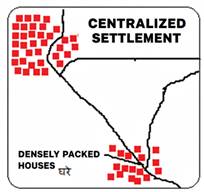
1) Compact Settlement / Centralized Settlement
In compact settlements, houses are built very close to each other with very little or no space in between. Such settlements may develop due to security reasons or around water sources like wells and lakes, especially in desert regions.
2) Semi-Compact / Fragmented Settlement
In this type, houses or groups of houses are built at some distance from each other and are found in small clusters. Such settlements are called semi-compact settlements.
3) Dispersed Settlement ( Scattered Settlement)
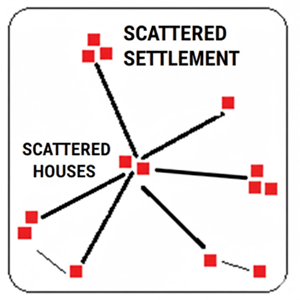
In dispersed settlements, houses are located far apart and their number is small. These settlements are commonly found in mountainous regions, dense forests, grasslands, and desert areas. They are also found in fertile alluvial plains with irrigation facilities.
4) Isolated Settlement
Isolated settlements are found in hilly agricultural regions. Some settlements consist of a main settlement along with small scattered groups of houses under its influence. Such settlements are called isolated settlements.

Useful notes for School work
very nice